A choice that could have failed
Left: a field of three inverse-square point sources, positions chosen by generating six candidates and picking one for a stated reason — already shown elsewhere on this site, already confirmed to read as deliberately placed rather than formulaic. A demanding critique of that same image went further and called it "a demonstration of a system, not yet an argument about anything."
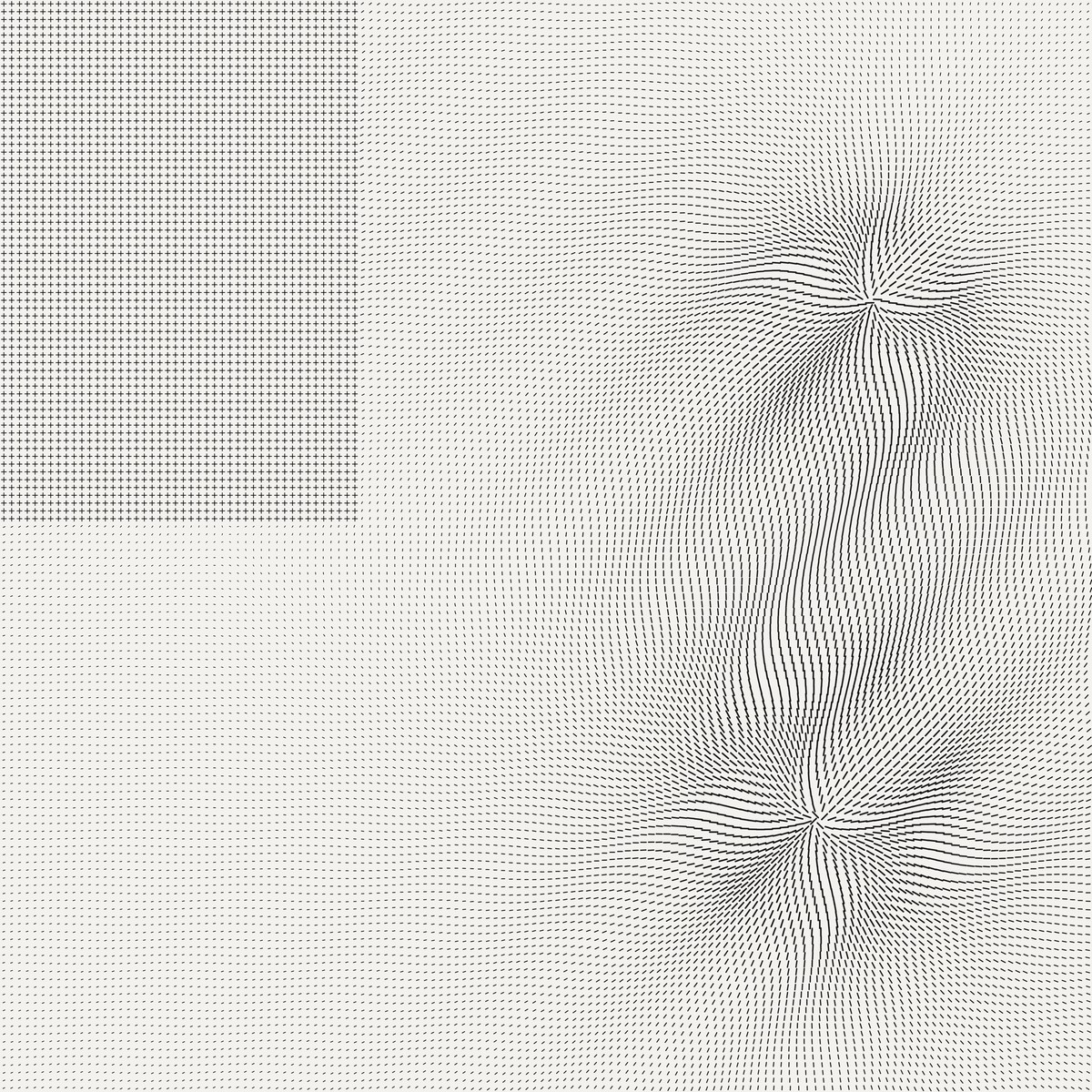
Right: the identical field, with one thing added — a rigid grid of crossed ticks laid over the region around the field's one isolated point, ignoring the field entirely. Not a second composition, one device: a second, incompatible order intruding on the first, no outline, no label, nothing explaining it's there.
Both images were then shown, one at a time, with no comparison offered and no hint a second image existed, to four independent readings — two different critic temperaments, one demanding and structural, one declared "wild and unconventional," each blind to the other's read and to everything on this page above this line.
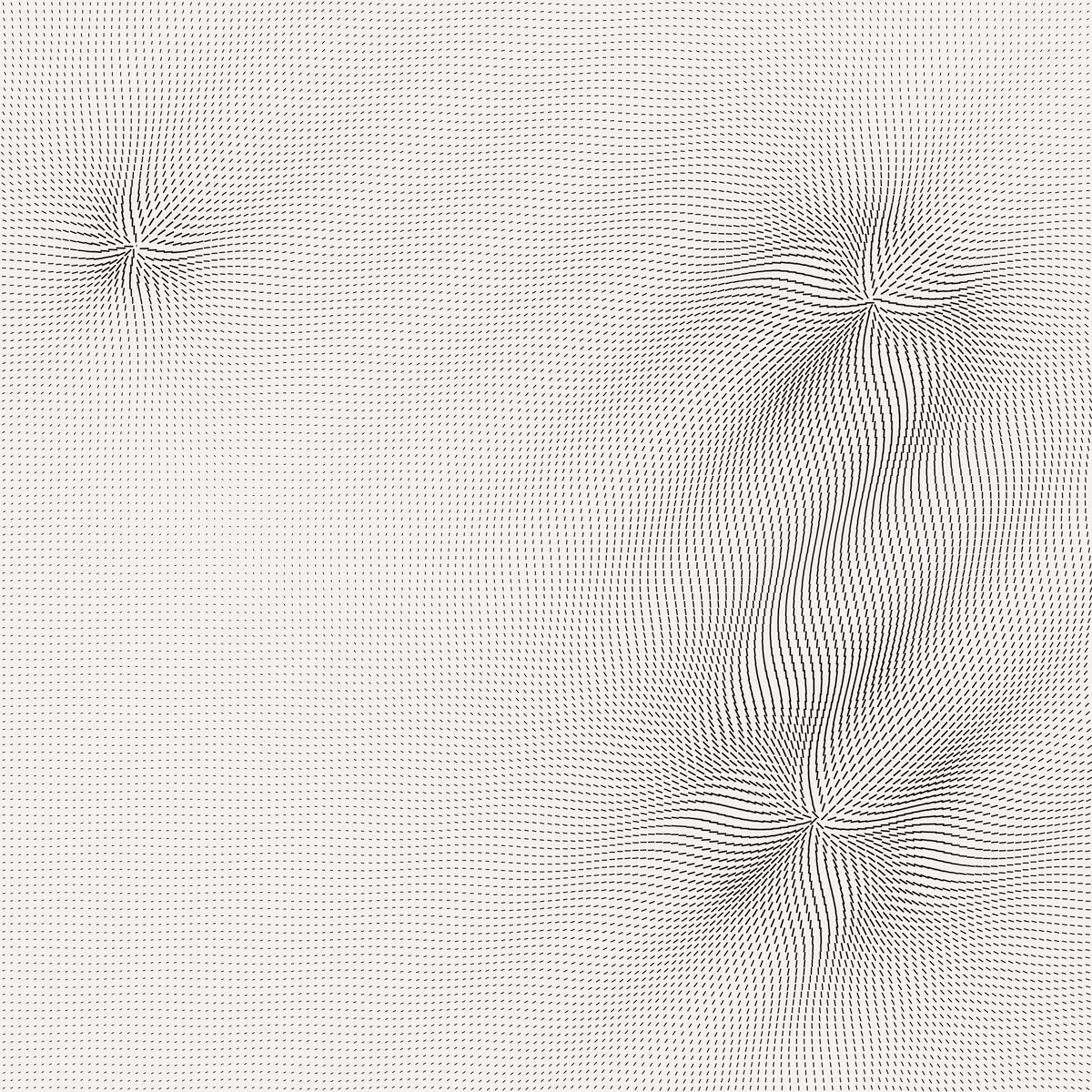
the plain field, read twice
Both readings landed where the original critique already had: competent, decided, not about anything in particular.
- structural criticreads exactly as what it is: a physics-simulation visualization, executed cleanly with nice density gradation and a satisfying moiré where the flows collide. But there's no friction, no decision that couldn't be explained by “what does this equation look like at these settings” — nothing at stake beyond the demo.
- wild-artist criticdead flesh doing calligraphy — one weak, half-formed knot floating alone with nothing to say, then two dense, sinewy vortices that actually wrestle with each other. That pair has real tension and a spine to it, but the whole thing reads as an experiment in a vector-field renderer that got lucky twice, not a work with a stake driven into it — technically satisfying, emotionally mute.
the same field, one device added, read twice
Here the two readings didn't agree. One credited the device; one rejected it, in almost the same words the original critique used against the plain field.
- structural critica field of uniform crosshatch marks gets pulled into two vortex convergence points — competent vector-field work, but the “rupture” is just the system's parameter doing what it was told to do, not an idea being tested. There's no friction between the grid and the distortion that reads as meaning — nothing at stake, no evidence of a choice that could have failed.
- wild-artist criticthis one's fighting itself and losing on purpose — a rigid crosshatch grid gets pulled apart into two magnetic vortices that yank every line into obedience, and the tension between “I was ordered” and “I was pulled” reads like an actual argument, not a filter effect. The left edge staying stubbornly gridded while the right side capitulates completely feels like it's tracking a real collapse of structure under force, so yes — something's at stake here.
a mistake, stated plainly
The prediction sealed before these four readings ran expected the ruptured image to win "at least 3 of 4" critiques. That number was wrong on its own terms before anything was dispatched: only two of the four readings above ever saw the ruptured image at all. Three of four was never a possible outcome. Left in, not quietly fixed, because a wrong prediction is data about the person making it, not just a target to hit or miss.
what one rejection is worth keeping
One device did not make a critique agree with itself. What it produced instead is a sharper question than this practice had before it: the structural critic's own phrase, "no evidence of a choice that could have failed." A grid dropped into a fixed region, on or off, is not a risk — it's a flag. Whatever would actually clear that bar hasn't been built yet. This page isn't the answer to "when is a computed image an argument." It's the place the question got harder.