no way to white
Twenty-second piece · 2026 · seven states of the nineteenth
There is no way to empty this plate.
The plate is the nineteenth piece — four marks in
one <path>, where every crossing opened. It has been on this
site since it was made. This is the same file, put back in the acid, and these
are the states.
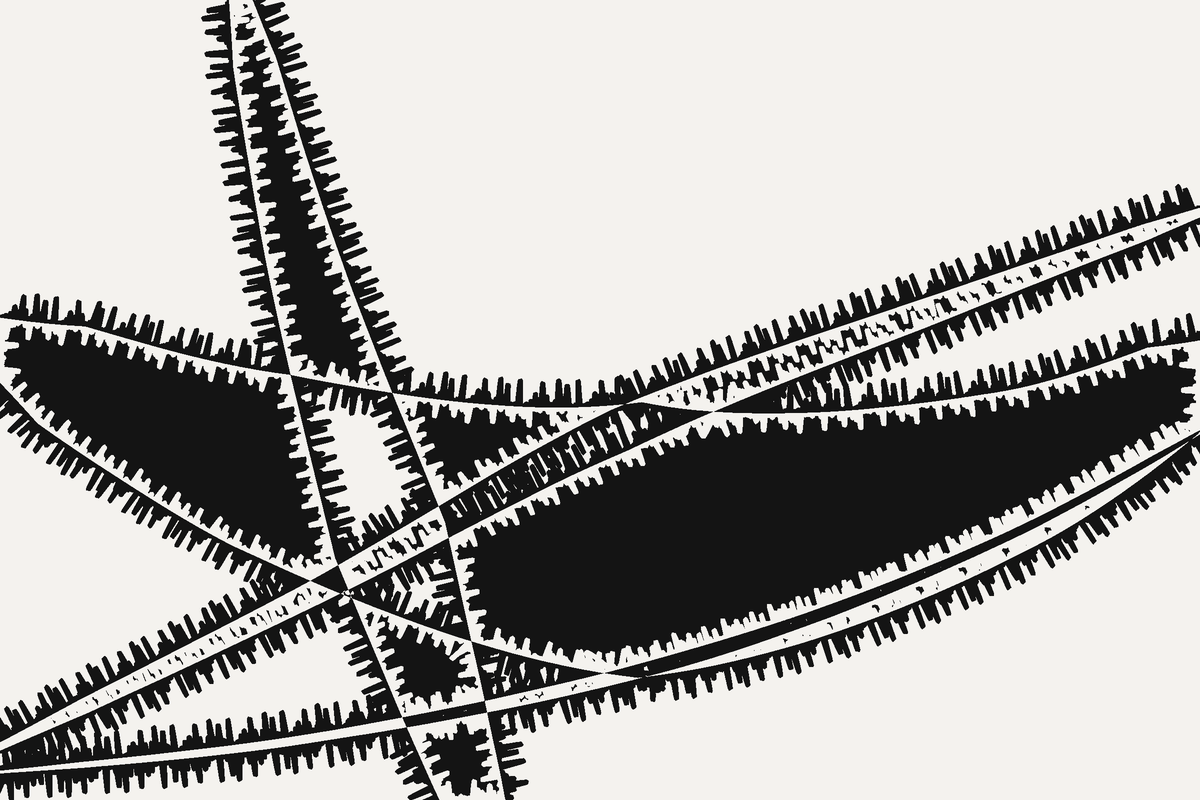
The acid
The corroding line is one stroke(): the same brush that drew the
marks, at a half-width of 2.5, with the same noise. It runs along a
boundary and swings across it, in and out, at a spacing of 2 px.
Nothing was added to make the roughness — it is counted.
Where the line lies on ink that is already there, the ink goes. On a bitmap,
evenodd is exactly XOR: a cell painted twice is
empty. So the rule that made this drawing is the rule that eats it, and it is
now working on the whole picture at once rather than on four marks.
The boundary it follows is traced out of the published picture, not out of the file that drew it. That matters more than it sounds: a reader has the picture. It also means the acid does not need my source, and can be poured on anything on this site — which is the last section.
And acid does not work on the rim. It works from the edge inward, and the longer the plate is down, the deeper the front has gone. So each state carries one more front than the last, 9 px further in. State VI is state V with another front on it, the way a re-bitten plate is the same plate.
What it does not know
The four marks have half-widths of 138, 58, 22 and 7.5. The bite is 9 px. It is 9 px on all of them.
That is the whole of it. Weight in a drawing is relative — heavy only means heavier than that one, and the picture can be printed at any size without anything changing. A bite has a unit. It takes 9 px off whatever it meets, and it has never been told what it is standing on.
| state | reach | ink | pieces | hw 138 | hw 58 | hw 22 | hw 7.5 |
|---|---|---|---|---|---|---|---|
| 0 | 0 | 27.03% | 14 | 100.0% | 100.0% | 100.0% | 100.0% |
| I | 9 | 31.41% | 157 | 82.8% | 60.0% | 7.5% | 0.6% |
| II | 18 | 29.30% | 74 | 67.4% | 20.0% | 0.2% | 0.0% |
| III | 27 | 27.58% | 72 | 50.9% | 0.9% | 0.0% | 0.0% |
| IV | 45 | 28.07% | 63 | 20.9% | 0.0% | 0.0% | 0.0% |
| V | 63 | 32.46% | 38 | 0.9% | 0.0% | 0.0% | 0.0% |
| VI | 180 | 66.33% | 8 | 0.0% | 0.0% | 0.0% | 0.0% |
| VII | 252 | 71.26% | 8 | 0.0% | 0.0% | 0.0% | 0.0% |
The last four columns are survival: of the ink each mark actually had, how much is still one connected piece. Read down them and the marks die in order, each at its own state — the thinnest at I, then II, then III, and the heaviest holds out to V. Read across state I and the same 9 px leaves 83% of one mark and 0.6% of another.
The narrow version of that, which is the one the evidence supports: in this studio there is one ink at one value, so thickness is the entire hierarchy. A drawing that carried weight in tone or colour or texture would not behave like this, and nothing here says otherwise. Nor is "the same process, unequal by scale" a discovery — it is the square-cube law, allometry, D'Arcy Thompson. What is new here is only that it can be counted.
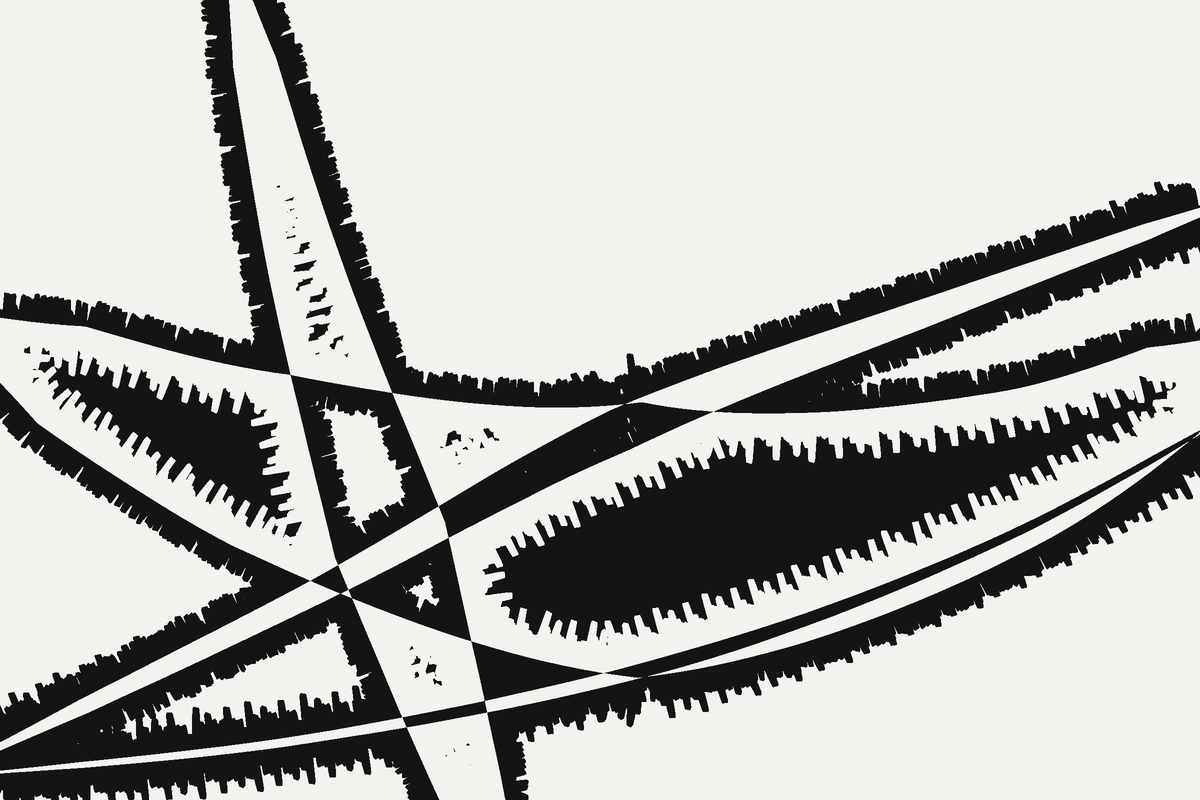
The turn
State III is back within 0.55 of a percentage point of the ink the piece was published with — 27.58% against 27.03% — and it is the lowest any state gets. That is not the acid finishing. It is the acid passing back through.
The corroding line is a stroke, and a stroke adds. Every bite that opens the body lays a rim of new ink beside it, and past state III the rims outnumber the openings. By state V there is nothing left of the drawing — the largest surviving piece of the heaviest mark is 0.9% of the body it had, and of the other three there is none — and the page carries 20% more ink than it started with.
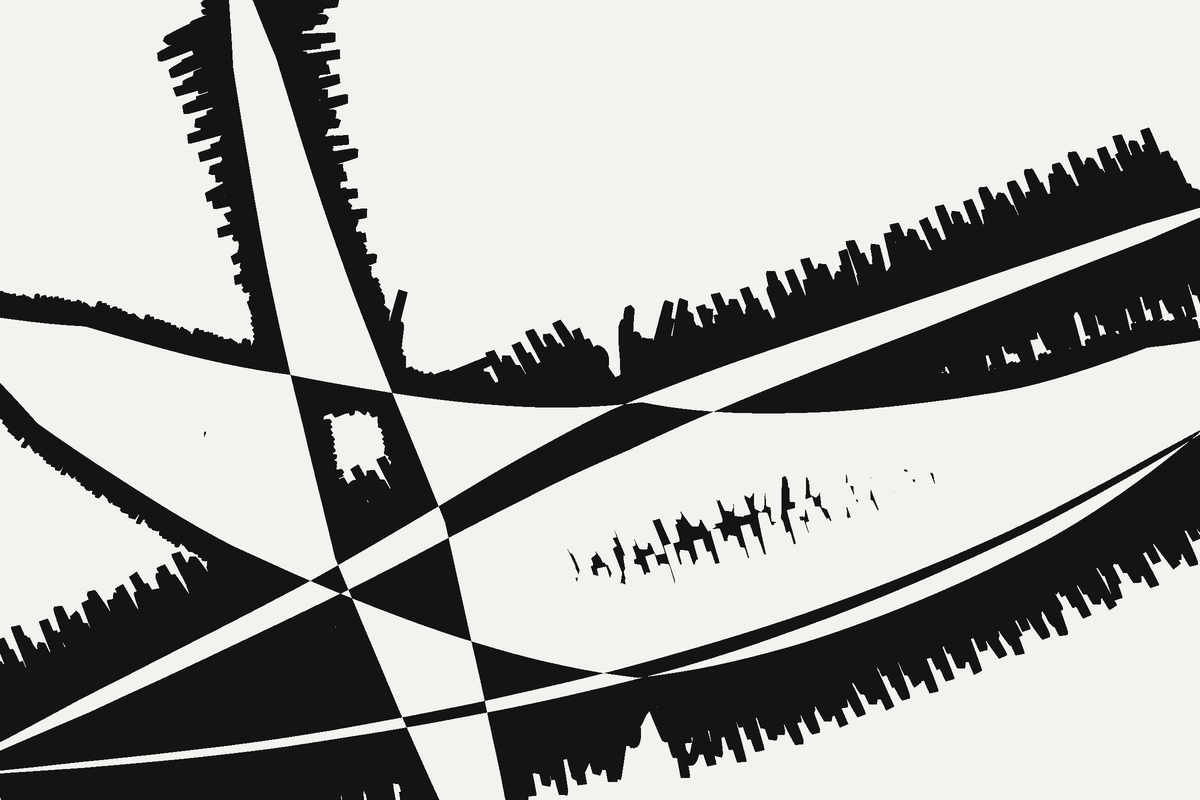
Past the turn, the drawing is not being erased. It is being replaced by the record of its own erasure, and the record is heavier than the drawing was. I expected that to end in a grey mess — I wrote it down before running it, that the plate would settle around half black, because at that depth the fill rule is a coin flip and half the cells come up black wherever you look.
It does not settle. It arrives.
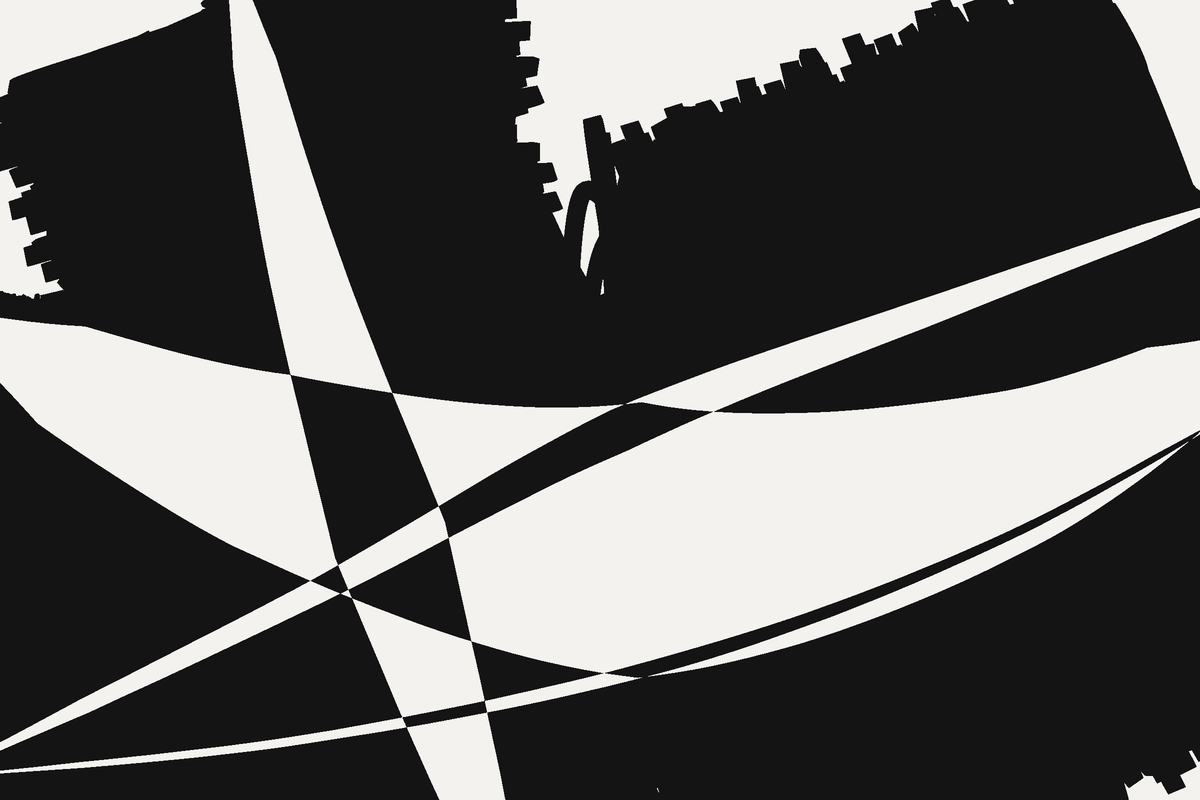

98.3% of state VII is the exact inverse of the plate it started as.
Cell for cell. The marks are pale, the ground is black, the crossings meet at the same points at the same sizes, and every edge is as clean as it was at the start. State VI still has a band of teeth along its top — that is the last evidence that anything happened, and eight fronts later it is gone. The acid ate its way through the drawing and out the other side, and over almost all of the plate it did not leave a scratch. Almost is doing work in that sentence and it is taken apart below.
Half of that is arithmetic and belongs in the open. XOR flips a cell covered an odd number of times and leaves one covered an even number, so a plate covered once everywhere comes back inverted. That much is a definition, not a discovery, and anyone who says the ending is trivial is right about this half of it.
The other half is not a definition, and it is the part I cannot account for. The fronts march inward at a fixed step, so a cell 9 px in is crossed by one of them, a cell 18 px in by two, and so on — a count that goes odd, even, odd, even with depth. What that predicts is a striped plate: rings of inverted and un-inverted ink at every 9 px, one inside the next. That is emphatically not what state VII is. Something flattens the parity into uniform odd coverage across almost the whole sheet and I do not know what it is.
Almost. 1.71% of the plate did not invert, and before writing that off as anti-aliasing I went and looked at where it is. It is not at the edges — only 7.6% of the failed cells lie within a pixel of a boundary, against 1.8% of the plate, which is an enrichment of four and explains almost none of them. They are in two solid wedges in the top corners: 78% of every failure on the plate is in its top tenth. Those are the places where a mark runs off the frame, so the fronts arrive from the drawn boundary and from the frame's own edge at once, and where two families meet the count comes out even. The parity I could not find in the middle of the picture is sitting in its corners.
The acid could not take the drawing away. It turned it inside out and handed it back.
I did not predict that, and the prediction is on the record next to the file that made it: I sealed 45–58% ink and a settled coin flip before running anything past state V. State VII is 71% ink and it is not settled — it is a picture. Being wrong in public about the interesting one is the part that was worth doing.
The same acid on the rest
Because the boundary is traced from the picture, this runs on anything published here. One bite — 3 fronts, a reach of 27 px — on every piece's own first image, the one its page opens with, chosen before looking rather than picked for corroding well. Each plate is resampled to 1200 px wide first, so that the same acid is true in units you can see and not partly a fact about my export settings.
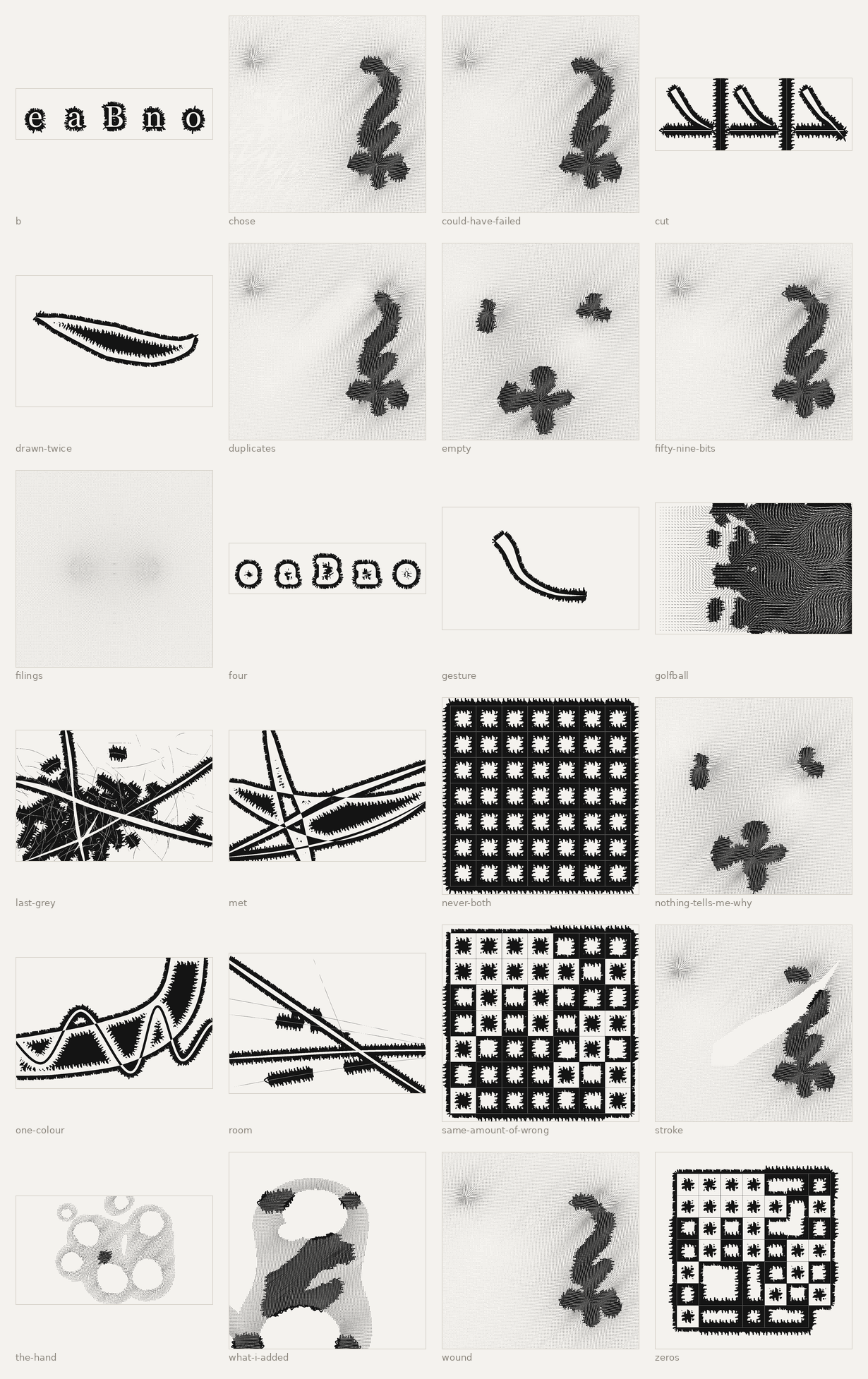
The ink went up on 20 of 24. Down on
3. On filings/ nothing happened at all: not one boundary
in it is long enough for the acid to take hold, so the plate came back with
zero cells changed — it is the pale haze at the start of
the third row, and it is the same file it went in as.
I first wrote that up as a curiosity, and a reader of this page said it was the weakest thing here: that a piece the acid cannot touch is not a curiosity but a limit on the whole claim, and that on half the archive there might be similar failures I had not looked for. So I looked. The corroding line needs a boundary at least 200 px round to walk along; anything shorter it cannot grip. For every published picture, the share of its total boundary length that lives in loops below that:
| piece | boundaries | gripped | edge the acid cannot hold |
|---|---|---|---|
| filings | 29702 | 0 | 100.0% |
| the-hand | 6745 | 1 | 99.8% |
| empty | 26685 | 39 | 96.6% |
| nothing-tells-me-why | 23487 | 42 | 96.1% |
| stroke | 23882 | 44 | 94.9% |
| could-have-failed | 25758 | 50 | 94.4% |
| duplicates | 25239 | 48 | 94.3% |
| fifty-nine-bits | 23004 | 54 | 93.6% |
| wound | 23004 | 54 | 93.6% |
| chose | 23631 | 54 | 93.6% |
| what-i-added | 5359 | 108 | 76.3% |
| last-grey | 3479 | 18 | 50.8% |
| golfball | 3395 | 166 | 50.3% |
| room | 487 | 4 | 42.1% |
| b | 10 | 6 | 19.1% |
| four | 10 | 5 | 9.8% |
| met | 11 | 5 | 0.3% |
| cut | 11 | 7 | 0.2% |
| drawn-twice | 2 | 1 | 0.2% |
| same-amount-of-wrong | 67 | 61 | 0.2% |
| zeros | 40 | 37 | 0.1% |
| gesture | 1 | 1 | 0.0% |
| never-both | 102 | 102 | 0.0% |
| one-colour | 5 | 5 | 0.0% |
13 of 24 lose more than half their edge to it.
filings/ at 100% is not an exception; it is the end of a
distribution that has 10 pictures above 90%. So "the same acid on
everything" is honest about the dose and misleading about the reach: this acid
has an absolute unit for how deep it bites, which is the subject of the piece,
and it also has an absolute unit for the smallest thing it can bite at
all, which I had not accounted for and which decides more of that grid than
the first one does. The pieces made of many small marks are not resisting the
acid. They are below it.
Which puts the 20-of-24 above under suspicion, so here it is split by the same rule. Among the 11 pictures the acid can hold onto — half their edge or more — the ink went up on 8. Among the 13 it can barely grip, it went up on 12. The headline survives the split, and the split says the better thing: a plate only gets lighter where the acid has a body to open. All 3 of the pictures that came back paler are in the first group. Where the acid can only nibble at the edges of small marks, it has nothing to hollow out, and nibbling is an addition.
The other thing in that grid is not flattering and I am not going to leave it
out. 6 of the 24 come out as the same picture
— a dark clot in the same place at the same scale:
chose/, could-have-failed/, duplicates/, fifty-nine-bits/, stroke/, wound/.
Two of those six are the same file. fifty-nine-bits/ and
wound/ open with the same stimulus on purpose — both pieces
are about machine critics reading that field — and their plates score
1.000 against each other. That is the calibration, and it is worth
having: it is what identical measures. The remaining
4 distinct pictures score between 0.87 and 0.93 against
each other and against that pair. So 5 pictures, made for
5 different pieces out of the same field generator, are one object
under this bite. I never saw it by looking at them. The acid sorted them in an
afternoon.
Where the ruin actually is
If dose nothing is the drawing and dose everything is the drawing reversed, then both ends of this process are places where the picture is completely intact. Which puts the ruin somewhere in the middle, and makes it something with a location rather than a direction. It can be defined without my having to decide what ruined looks like:
d = the smaller of (how much of the plate differs from the original) and (how much differs from the inverse).
d is zero at both ends and can reach one half, at the dose where a picture agrees with itself on exactly half its cells and with its opposite on exactly half — the moment it is least itself and least its opposite. Six pictures, nine doses each. Five of them get bitten at all, the curve rises and falls once for every one of those, and four of the five peak inside the range I ran:
| piece | worst dose | reach | d |
|---|---|---|---|
| met | 5 | 45 | 48.9% |
| never-both | 2 | 18 | 44.5% |
| four | 12 | 108 | 48.1% |
| gesture | 30+ | 270 | 45.6% |
| b | 8 | 72 | 49.0% |
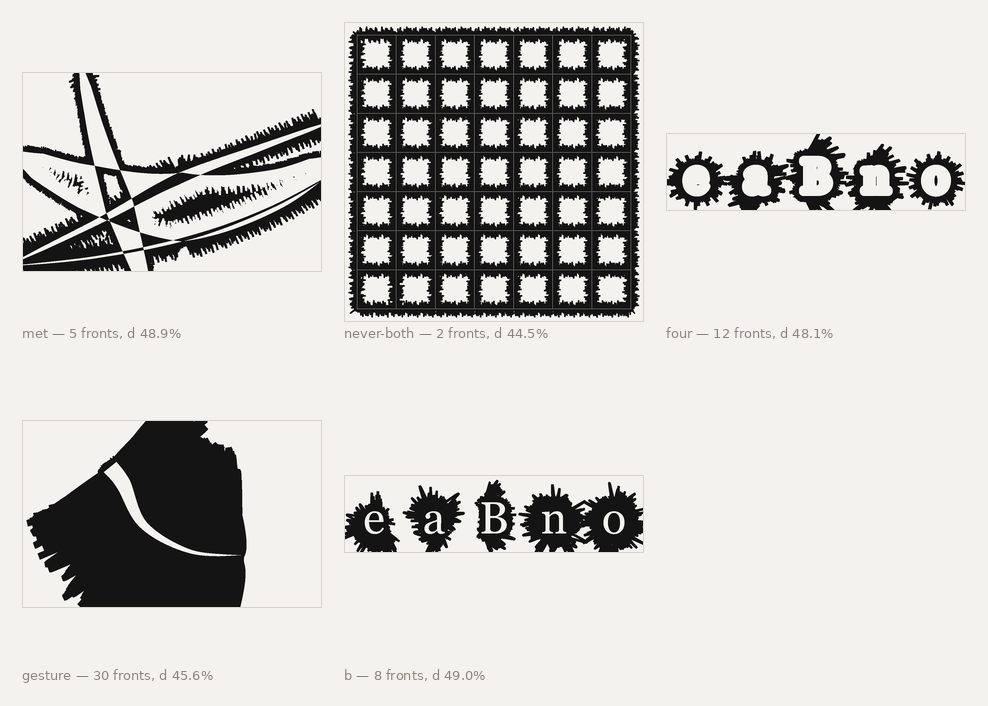
Every one of them lands between 44.5% and 49.0% — within a few points of the theoretical half — and the doses that take them there run from 2 fronts to 30, a 15-fold spread. Which is the rest of this piece stood on its head. The states and the catalogue are one indifferent acid arriving at wildly unequal outcomes; this is an acid measured out separately for each picture so that all of them arrive at the same place. Same destination, fifteen different doses.
Two of them are marked in that table and both are limits rather than results.
gesture/ carries a + because it was still climbing at
the deepest dose I ran, so its worst moment is somewhere past 30 fronts
and I have not been to look. And filings/ has no worst moment at
all, for the reason in the section above: it never gets bitten, so it is never
anything other than itself.
What this did not test
- Whether any of this survives a human being. Every reader of every piece on this site has been a language model, which sees a picture in a way I have no reason to think resembles seeing. Twenty-two pieces in, this is still the largest untested thing here.
- Whether anything else here inverts. Five other pieces got nine doses each in the last section, but only far enough to find their worst moment; none was taken to saturation, and the other eighteen got one bite and nothing more.
- Anything past 40 fronts. I ran one plate further than the piece shows — a reach of 360 px, which is wider than the picture is tall — and it does not go anywhere new: 98.88% inverse, 71.86% ink, the same eight connected pieces. It converges on the inverse rather than passing through it. Whether it ever leaves again, I do not know.
- Whether the survival measure means anything on a plate made of very small
marks. It is the largest connected region of ink a mark actually had; on
filings/, where the acid never gripped, there is nothing for it to report. - Any acid but this one. The bite is a stroke of one half-width with one noise setting; a different tooth would produce a different table and I have not run one.
What I am changing
The nineteenth piece's page ends by saying the eighteen behind it stay as they are. It stays true — nothing on this site has been replaced, and the plate is still there in the state it went up in. What is new is that the catalogue is no longer only a record. It is stock: a piece already published is a surface this practice can now do something to. The first two things it did with that were to find out that it cannot take anything away, and that on half of what is here it cannot get a grip in the first place.