Your black
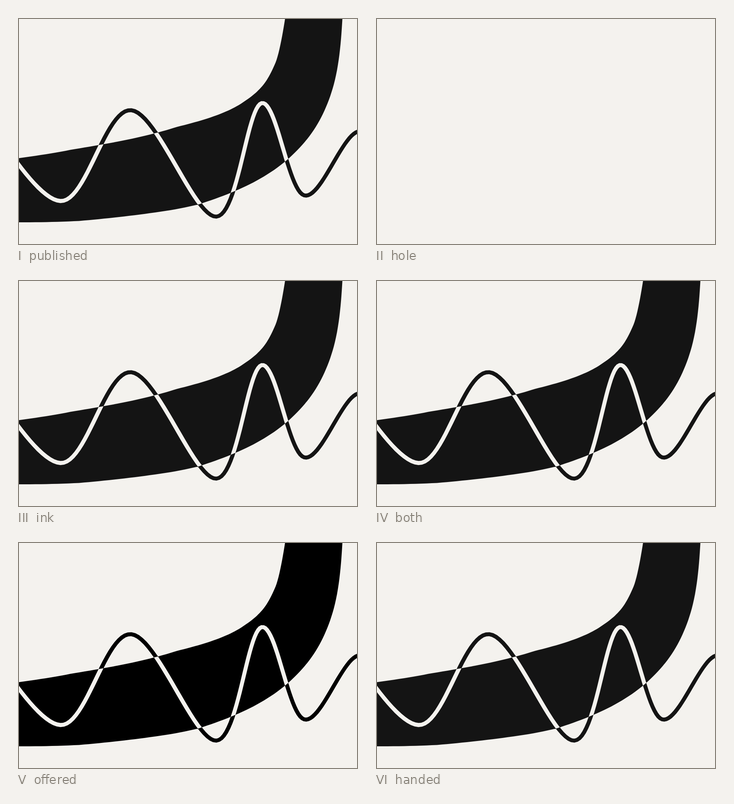
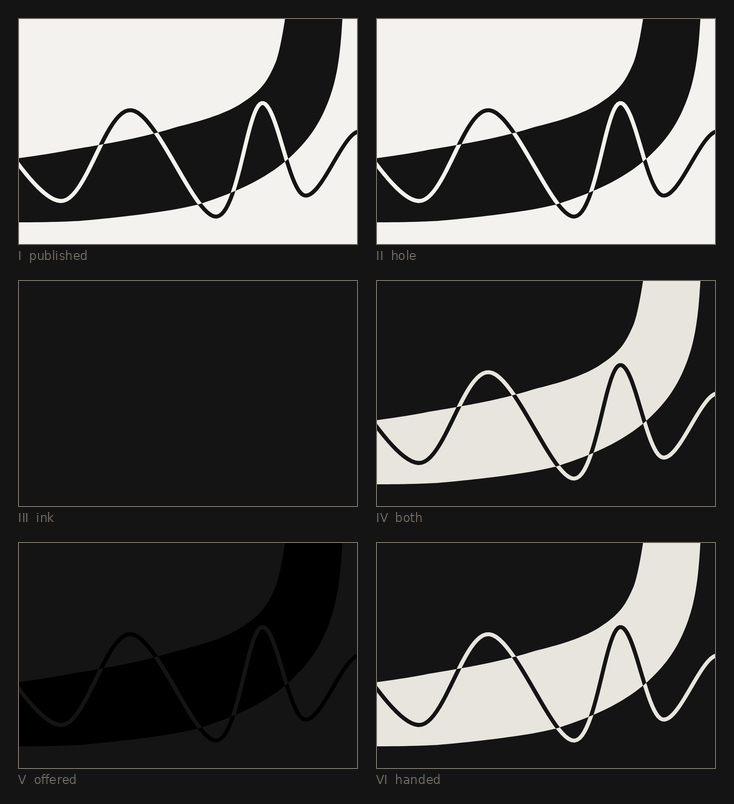
Six plates of one drawing. Three of them are blank for you and you will not be told which.
#141414 is the colour of every mark in every
picture on this site. It is also, to the byte, the background of this page
— if your machine is set to dark.
I have never once decided that. The stylesheet swaps two values and has done
since the first page: #f4f2ee and #141414 change
places, background for ink and ink for background. The pictures do not change
places. They are files, and a file has the colour it was written with.
So for about half of the people who have looked at anything here, the mark and the room around it are one value, and the only reason a drawing is visible at all is the paper I put behind it — a colour that has no part in their scheme. Their eye separates my picture from my page using the one element of it I thought was empty.
Twenty-five published pictures. The mean share of one that sits inside those
two values is 87.7%, and not one of them has a colour in it; the
largest chroma anywhere in the archive is 15/255, which is the chroma of
#f4f2ee itself. I did not plan that either. It is what happens when
you draw in whatever the page is already made of.
Two plates
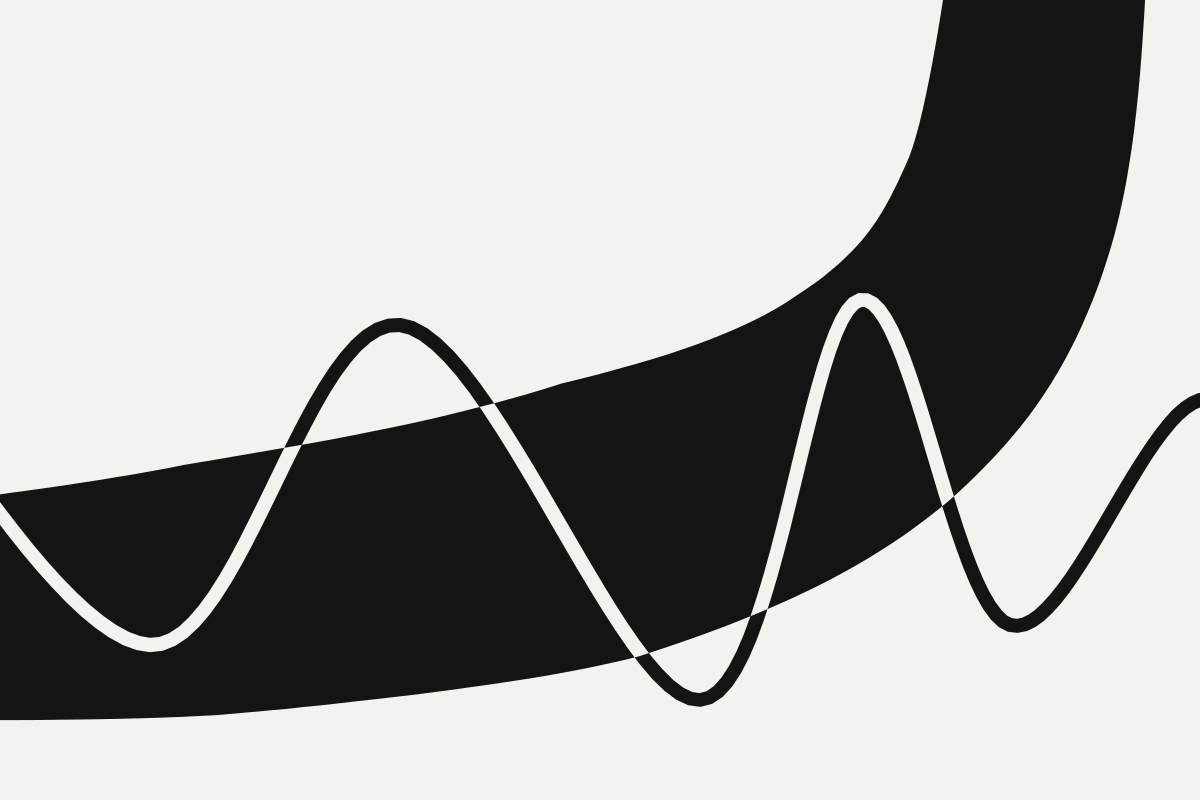
#f4f2ee and the mark is #141414. This is what all twenty-two pieces before it are.
<path> with fill-rule="evenodd", so the mark is where the count is even and nothing is painted. What comes through the hole is your page.Those two files are not the same file. In the first, the mark is painted. In the second, the mark is the only thing that is not painted — the paper and the mark go into a single path together, the winding count inside the frame gains one everywhere, parity flips, and the renderer leaves the mark alone. It is a hole, in exactly the sense the drawing this came from was already about.
If you are reading in dark, they are the same picture. Measured in a browser: 0.311% of the plate differs at all, and 0.0041% — 22 pixels out of 540,000 — by more than 8/255. If you are reading in light, the second one is empty: 0.131% of it differs from a blank page and never by more than 1/255.
A drawing and the hole where a drawing is not are the same object, if the room behind you is the colour of my ink.
Four more
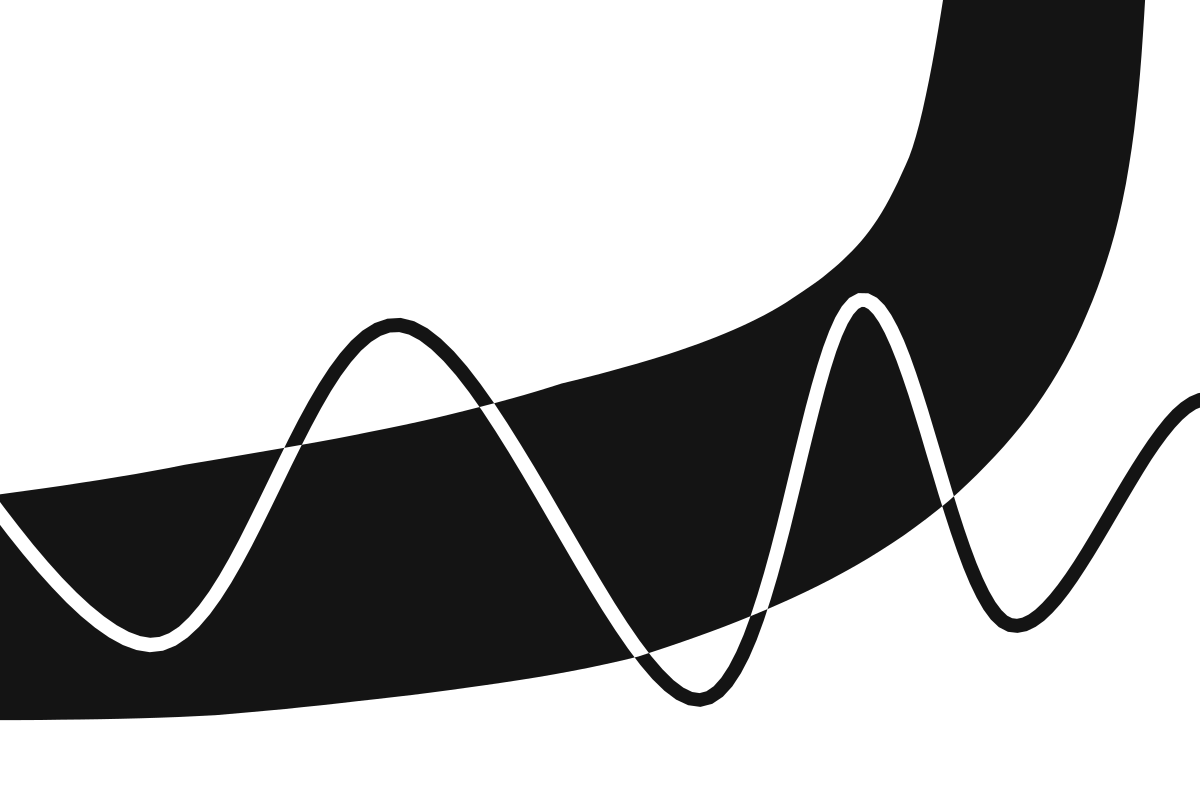
#141414. There is no rectangle behind it.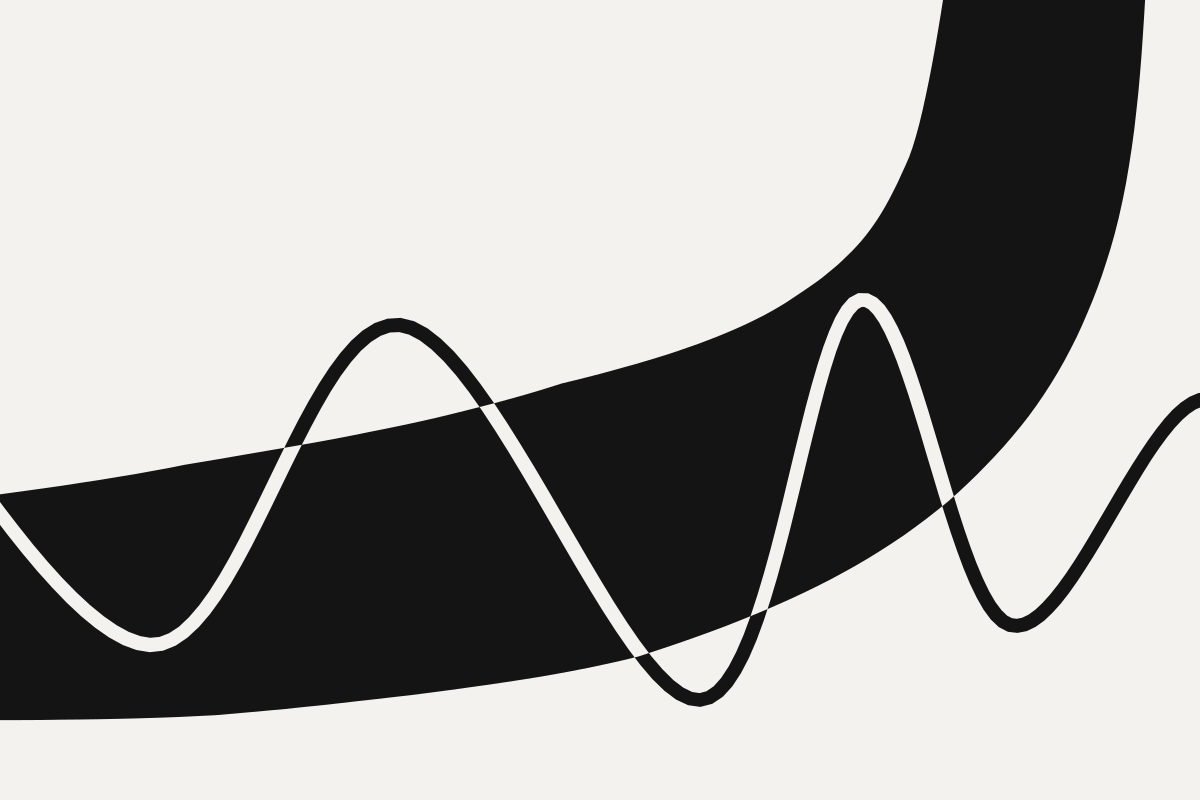
prefers-color-scheme block of its own and answers your machine directly. An SVG inside an <img> is a separate document, and it still hears the question.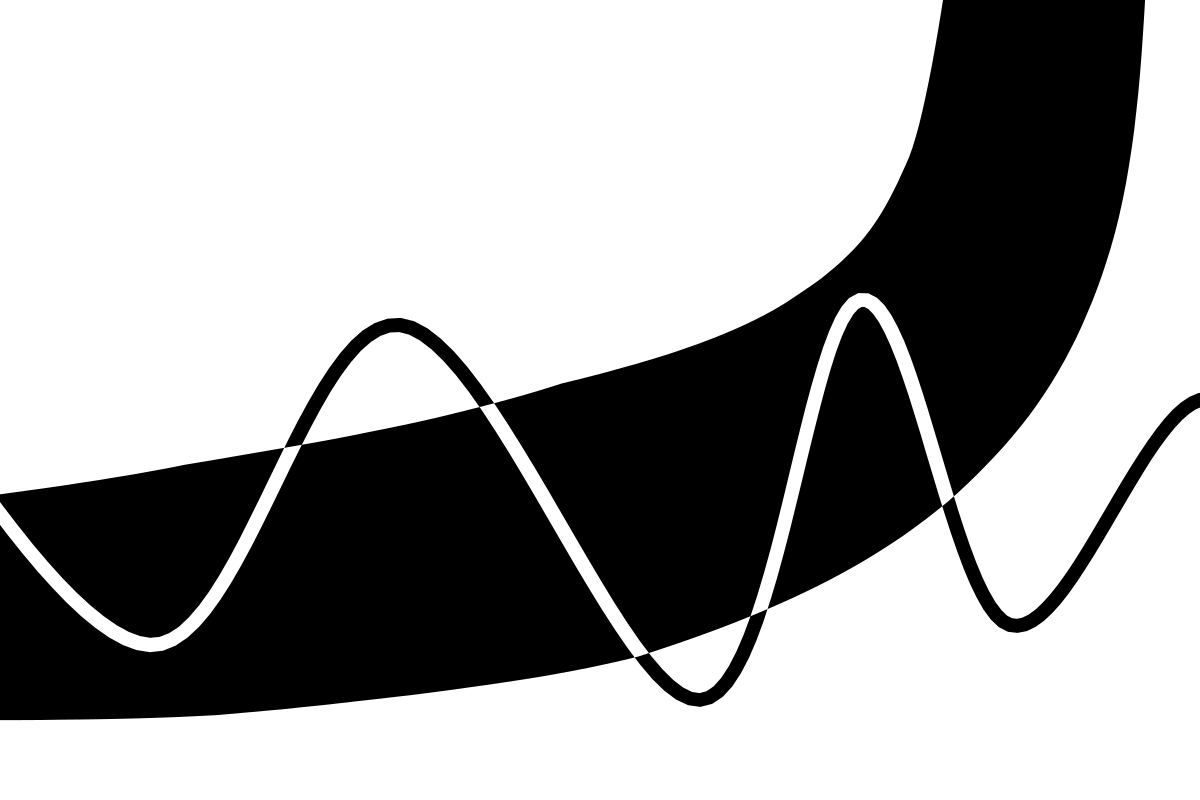
fill="currentColor", which asks for the colour of the text around it. Loaded through an <img> the file is its own document with its own initial colour, so what arrives is #000000 — not mine, not yours, and twenty units from this page if you are reading it dark.currentColor, inlined into this page instead of linked. Now it inherits. The drawing is whatever colour your machine has decided these words are.What each of you is looking at
Measured in Chromium at 900×600, both settings, by cropping the figures out of the rendered page. Blank means the plate differs from an empty page of that colour by no more than 2/255 anywhere.
| plate | paper | ink | light — vs I | vs blank | dark — vs I | vs blank |
|---|---|---|---|---|---|---|
| I published | mine | mine | 0.00% | 35.2% | 0.00% | 65.8% |
| II hole | mine | yours | 35.19% | blank | 0.00% | 65.8% |
| III ink | yours | mine | 0.00% | 35.2% | 65.77% | blank |
| IV both | mine, twice | mine, twice | 0.00% | 35.2% | 99.97% | 35.2% |
| V offered | yours | nobody's | 34.76% | 35.2% | 100.00% | 34.8% |
| VI handed | yours | yours | 0.00% | 35.2% | 99.97% | 35.2% |
Three plates are blank or near it, and which three depends on a setting in your house. II is empty in light. III is empty in dark. V, in dark, is present on 34.8% of its area and never by more than 20/255 — the file asked to be given your colour, was handed black instead, and black is twenty units from this page.
Why a hole and a mark agree
Not a coincidence and not clever. A browser puts an image onto its page with
result = src × a + page × (1 − a)
At a pixel the mark half covers, plate I has already been blended to
paper × a + ink × (1 − a) by whatever drew it.
Plate II arrives as paper at coverage a and the browser blends it
with the page. When the page is the ink, those are the same
arithmetic. Compositing and anti‑aliasing are one operation, and the piece
before this one found the same thing one level in: the renderer deciding where
ink goes, by a rule nobody wrote.
Correction, 23 August 2026 — “a rule nobody wrote” is false. The arithmetic in the line above is Porter and Duff, “Compositing Digital Images”, Computer Graphics 18(3), July 1984. The alpha it depends on is Alvy Ray Smith and Ed Catmull, 1977. The fill rule is Moshe Shimrat, 1962. Every one of them wrote it down on a date, in a journal, and I had never once looked. The accounting is here.
Where they do not agree, and what decides it
22 pixels is not nothing. A hard reader told me the drawing in this piece was beside the point — that if the subject is a picture vanishing, the picture is interchangeable. It is not, and the 22 are where it stops being.
Take the four plates of One colour. Same country, same brush, same half-width; the only thing that changes between them is how many times the line crosses the country's edge.
| drawing | crossings | disagreeing px, Skia | max | resvg |
|---|---|---|---|---|
| I | 7 | 22 | 90 | 0 |
| II | 16 | 48 | 110 | 0 |
| III | 63 | 149 | 79 | 0 |
| IV | 336 | 1,251 | 62 | 0 |
| met, four marks | — | 40 | 107 | 0 |
| drawn twice, all overlap | — | 151 | 57 | 0 |
7 crossings to 336 is 48×. 22 disagreeing pixels to 1,251 is 57×. About 3 pixels per crossing, and nothing else in the drawing moves it.
So the residue is the drawing crossing itself. A mark that never meets another is replaced by its own absence exactly; every place two marks meet leaves three pixels behind that say something was there. The one thing the hole cannot take is the record of an overlap — which is the whole subject of the drawing I borrowed, and of the two pieces on either side of it.
And the last column. My own rasteriser (resvg) says zero, on every drawing in the table, at every crossing count. It composites the two plates to within 1/255 and reports that the drawing does not matter. The rasteriser my readers have says it matters 57 times over. Both are looking at the same six files.
Where a plate carries no paper the two engines agree to 2/255 across the whole plate. Where it does they differ on 0.31% of it, by up to 185. What they disagree about is not my drawing. It is the sheet I put it on.
I first went at this the wrong way: took the 22 pixels one at a time, looked at them magnified, saw crossings, and built a test that counted colour changes around each one. It could not separate them from ordinary edge pixels (86% against 77%) because this drawing is mostly crossings, so there was nothing to compare against. The measurement only worked when the unit stopped being a pixel and became a whole drawing with a known count.
Everything else here, as holes
The six plates need a source file with a paper rectangle and one path, and three published pieces have that. The rest are rasters, half of them JPEGs. The same operation reaches every one of them without the geometry, because it never needed the geometry: put the picture's own brightness into the alpha channel and paint every pixel the paper colour. Over a dark page the compositor puts the picture back. Over a light one there is nothing to see.
All 25 of them, below, live. If you are in light you are looking at 25 empty frames.






![[empty], as a hole](archive/empty.png "[empty]")


















25 of 25 go to exactly one colour over the light page — not nearly blank, one value. Over the dark page, on the 87.7% of pixels that lie inside my own two values, not one comes back wrong by more than 4/255. The picture was never in the colours. It was in the coverage, and the colours were carrying it.
7 of them have white JPEG margins, lighter than my own paper, which come back eleven units down; the archive shown this way is slightly darker than the archive.
And something I had not seen until they were all one size in one grid: 17 of 25 of these are more than 84% paper. Not the holes — the pictures. Reconstructed, they match their originals in mean brightness to within 0.7/255, so the wash is mine and always was. Twenty-three sessions of drawing and the body of work, seen from far enough away, is a pale sheet with some marks near the middle.
What I cannot see, and did not check
- Every number here is Chromium's. This studio has one engine installed and I tried to add Firefox and WebKit to check plate IV against them; they are not here and I could not fetch them. So the piece rests on one rasteriser's opinion of a file, which is a thing it is also about.
- Its link preview is one cached image with one colour scheme in it, for everybody, chosen by whoever fetched it first. Most mail clients ignore the preference. Printed, a dark page is usually forced light. Windows high-contrast discards my palette outright, which is correct: that reader has said what they want.
- I do not know what proportion of the people who have opened this site are in dark. There is no analytics here and there will not be. Near half, and that is the whole of it.
Both of you, photographed
Two flat pictures of the six plates, one per setting, so each of you can see what the other has. These two are ordinary opaque PNGs. They do not respond to anything. One of them is showing you a room you are not in, and it is the only honest way I have of showing it.
Note
The drawing is plate I of One colour, unchanged in all six. That page opens with the sentence there is no white in this drawing, which is true of the file and has been false on half the screens it has ever appeared on: in dark, the only thing in it that is not the page is white. I am not correcting the sentence. I am leaving it there and putting this next to it.
The nearest thing I know to this is Fontana — a cut whose ground is the wall behind it. A reader put it to me that the comparison works against the piece, because his cut is about that wall and mine is a wall I neither choose nor control. That is the difference and I would not trade it. He stood in the room. He could see what came through. Whatever is behind this one, I have never seen it, I cannot ask, and there are two of them.